 Mintable
 helped develop ERC-2981 to standardize NFT royalty information
Updated -
Mintable helped develop ERC-2981, which lets NFT contracts report a royalty recipient and an amount based on the sale price. Marketplaces choose whether to honor that information and handle the payment. The team announced an NFT platform wind-down in 2026, so its historical work does not establish current marketplace availability.
Creation costs and resale royalties served different purposes
Mintable’s gasless Ethereum minting addressed creation costs, while its work on royalty standards addressed information that marketplaces needed for sales. For marketplace sales, relying on ERC-2981 required both contract support and a venue that honored it. Avoiding minting gas fees did not establish a royalty rate or commit a marketplace to paying it.
The royalty query identifies a recipient and an amount
The
royaltyInfo()
function takes a token identifier and sale price, then returns a recipient address and royalty amount. The contract defines how those inputs map to that response. Its token identifier selects the asset within that contract, so the number alone does not identify an NFT across unrelated contracts.
A query does not execute the payment or confirm receipt. ERC-2981 leaves the transfer mechanism to the implementation that handles payment.
The sale price supplies the calculation base
ERC-2981 bases the royalty on the sale price that the caller supplies, without subtracting the seller’s purchase cost. The royalty amount must represent a percentage of the supplied sale price. Seller profit and the NFT holder’s wallet balance therefore do not supply the calculation base. The standard does not set one percentage for every NFT.
The function returns an amount, rather than just a rate. An honoring payer must use that returned amount for the supplied sale price.
Both monetary values must use the same unit of exchange. The interface does not identify a currency or convert between assets.
A compliant calculation cannot ignore the sale price and return a fixed monetary charge. It also cannot choose its percentage by comparing the sale price with fixed numerical thresholds. Those approaches would assume a currency or scale that the interface does not know. Other predictable contract conditions can affect the percentage without changing this sale-price basis.
No query establishes future royalty income. Its amount describes a royalty for the given sale price, and payment still requires an entity that honors the standard.
Does ERC-2981 charge royalties on every wallet transfer?
ERC-2981 does not automatically charge a royalty on every transfer, because moving an NFT between wallets does not necessarily constitute a sale. The standard deliberately leaves royalty participation voluntary. ERC-721’s
transferFrom()
supports ordinary transfers without establishing whether a sale occurred. A successful ownership transfer consequently does not establish that anyone calculated or paid a royalty, even when the NFT contract supports the royalty interface.
Compare royalty handling before choosing a resale venue
A marketplace honoring ERC-2981 and a marketplace using its own royalty system can apply different payment rules to the same NFT. Compare them by the recipient and payment that their sale rules provide. For the standard-based route, the sale-price input and applicable contract logic determine the royalty, without establishing a fixed payout beforehand.
- Establish whether the NFT contract supports ERC-2981 before relying on the standard-based payment route.
- Keep the same contract and token identifier when comparing how the venues handle that NFT.
- For the ERC-2981 route, interpret the returned amount using the actual sale price and its monetary unit.
- For a separate royalty system, establish its recipient and calculation rules without assuming that they match ERC-2981.
- Choose the venue whose applicable sale rules honor the intended royalty, then distinguish its quotation from an executed payment.
A royalty payment record should match the recipient, amount, and unit for the relevant sale. A record of the NFT’s ownership change alone does not establish that payment. A venue using another royalty mechanism may pay royalties without implementing ERC-2981; lack of this interface alone does not settle that comparison.
Contract state can alter the percentage
An implementation may vary its percentage by token identifier or predictable contract state, including the NFT’s transfer count. ERC-2981 does not require every collection to use these options. A later query can return a different amount despite an unchanged sale price. The standard discourages unpredictable timing variables such as
block.timestamp
, because delayed queries can change expected amounts.
Rounding and zero returns affect payment interpretation
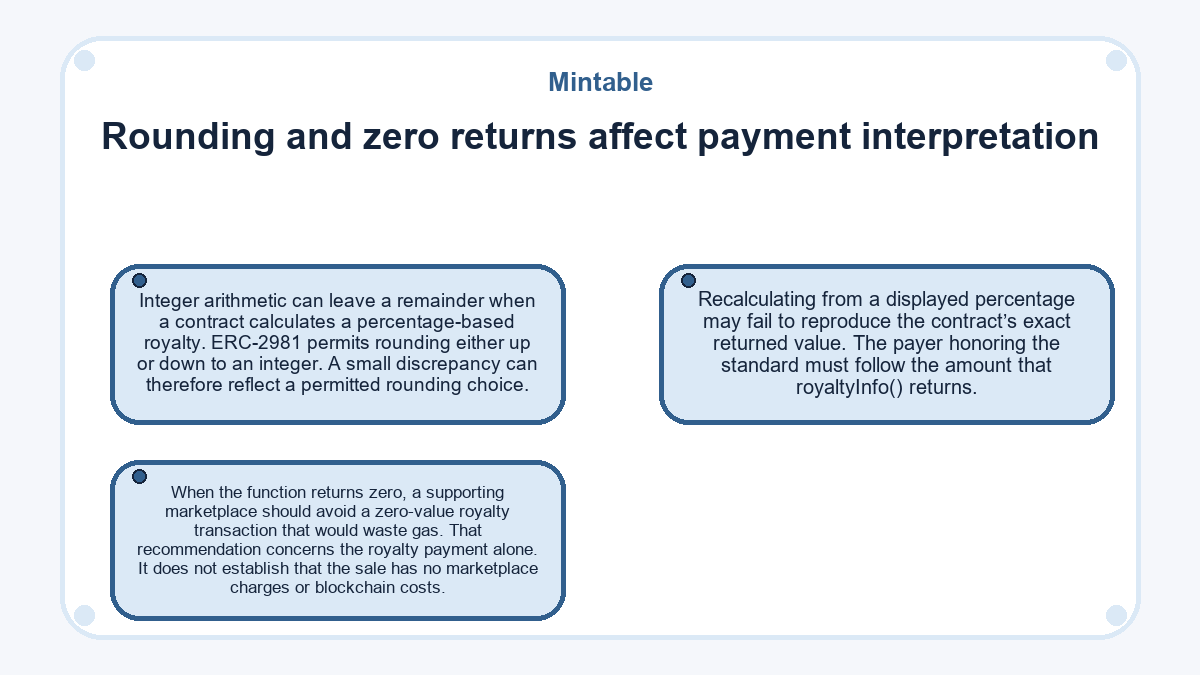
Integer arithmetic can leave a remainder when a contract calculates a percentage-based royalty. ERC-2981 permits rounding either up or down to an integer. A small discrepancy can therefore reflect a permitted rounding choice. Recalculating from a displayed percentage may fail to reproduce the contract’s exact returned value. The payer honoring the standard must follow the amount that
royaltyInfo()
returns.
When the function returns zero, a supporting marketplace should avoid a zero-value royalty transaction that would waste gas. That recommendation concerns the royalty payment alone. It does not establish that the sale has no marketplace charges or blockchain costs.
Mintable’s wind-down and royalties on later sales
In 2026, the team announced the wind-down of Mintable and Mintology while describing a business pivot. ERC-2981 describes an interface that other contracts and marketplaces can implement, so the platform announcement does not determine another venue’s royalty policy.
The announced custodial wallet migration addressed access to users’ wallets, while metadata hosting concerned continued availability of NFT data. Neither commitment promised royalty payments on later sales. An existing NFT’s contract support and a sale venue’s payment rules determine how ERC-2981 applies. A historical connection to Mintable alone establishes neither universal contract compatibility nor a completed royalty payment.
What to know about Mintable
Must an NFT contract use ERC-721 or ERC-1155 to implement ERC-2981?
ERC-2981 does not require a contract to implement ERC-721 or ERC-1155. It supports those NFT standards, while other contracts can implement the royalty interface if they uniquely identify the relevant assets within its constraints. ERC-721 or ERC-1155 compliance alone does not establish ERC-2981 support.
How does ERC-165 identify support for the royalty interface?
ERC-165 lets a contract report whether it supports a specified interface. For ERC-2981, that interface identifier is 0x2a55205a, which an integration can check through supportsInterface(). This identifies declared royalty-interface support. It does not establish a particular percentage, guarantee correct contract behavior, or show that a marketplace has made a payment.
Can an ERC-2981 royalty support payments to several collaborators?
An ERC-2981 recipient can handle payment splitting through a receiving contract or an off-chain process. The royalty query itself returns one recipient address and one amount. It does not define a list of collaborator allocations or execute those distributions. Any splitting arrangement therefore needs additional logic outside the royalty interface.
Do off-chain NFT sales follow the same royalty currency rule?
Entities honoring ERC-2981 must apply its royalty rules to off-chain sales as well as on-chain sales. This scope includes over-the-counter transactions and auction-house sales. The royalty must use the same currency or token as the sale price. The interface does not itself arrange settlement for those transactions or force entities to adopt the standard.
When does ERC-2981 notify a recipient that a royalty has arrived?
ERC-2981 does not specify a notification mechanism or notification deadline. It defines how to retrieve the recipient and royalty amount, while payment delivery and notification require arrangements outside that interface. Interface support therefore does not establish how a particular marketplace alerts recipients or when it processes their payments.
Who co-authored the royalty standard associated with Mintable?
Zach Burks, James Morgan, Blaine Malone, and James Seibel co-authored ERC-2981. The proposal records September 15, 2020, as its creation date.
Why can an NFT’s owner differ from its royalty recipient?
An NFT’s owner and its royalty recipient have different roles. ERC-2981 supplies an address for royalty payments to a creator or rights holder, while token ownership identifies the holder of the NFT. The interface does not require those addresses to match. Ownership alone therefore does not identify the destination that a royalty query will return.