 Mintable
 gasless minting and the fees creators avoided
Updated -
Mintable gasless minting let creators avoid the gas payment for creating an Ethereum NFT. Creators signed a message instead of submitting their own minting transaction. The saving concerned creation; subsequent Ethereum transfers had separate gas costs. In 2026, Mintable announced its NFT platform wind-down, so the gasless creation flow belongs to the service’s operating history.
A token’s on-chain existence, its wallet thumbnail, and its listing each represented a different state. Confusing those states could lead a creator to pay for a transfer merely to fix a display problem.
Bottom line: A wallet that supported manual NFT entry could display an existing token without a transfer that incurred gas fees.
Gasless creation alongside creator-funded minting
Choosing the Mintable Gasless Store removed the creator’s minting gas payment, while traditional Ethereum minting involved creator-funded transactions. Mintable’s gasless creation flow produced ERC-721 NFTs on Ethereum mainnet. The token standard described the NFT’s interface; the network identified where it existed. Creators could use the gasless method without holding ETH specifically to fund that mint. A historical Mintable interface also offered an Immutable X route, which used a layer 2 network. Both options advertised minting without creator gas fees. They remained separate network choices, so instructions for one route did not automatically describe the other.
Why did a gasless NFT sometimes stay out of the wallet display?
An NFT could stay out of a wallet’s gallery because gasless creation did not immediately emit the Transfer event that many wallets used for detection. The item could already exist on Ethereum while the gallery remained empty. A later purchase or manual transfer supplied that event. Wallet visibility alone therefore could not establish whether creation had succeeded. Where a wallet supported manual NFT entry, the contract address and token identifier offered another way to display the item. Manual addition changed the wallet’s presentation without moving the token. Transferring it solely to trigger detection involved a separate blockchain action and its associated gas cost.
Network gas and marketplace deductions followed different inputs
When a creator later submitted an Ethereum NFT transfer, that transaction required ETH for gas even after free creation. An Ethereum transaction’s gas cost equals the gas used multiplied by its effective gas price. Gas use measures computational work. Network demand affects the price of that work, so an identical kind of transfer can cost different amounts at different times.
The NFT’s asking price did not supply the calculation base for its network gas bill. Marketplace deductions followed a separate calculation: Mintable’s collection-listing tools displayed earnings after marketplace fees. Those deductions reduced sale proceeds, while gas paid for blockchain execution. NFT royalties concerned another payment relationship, with conditions set by the relevant contract and sale venue.
The shared store’s features shaped the trade-off
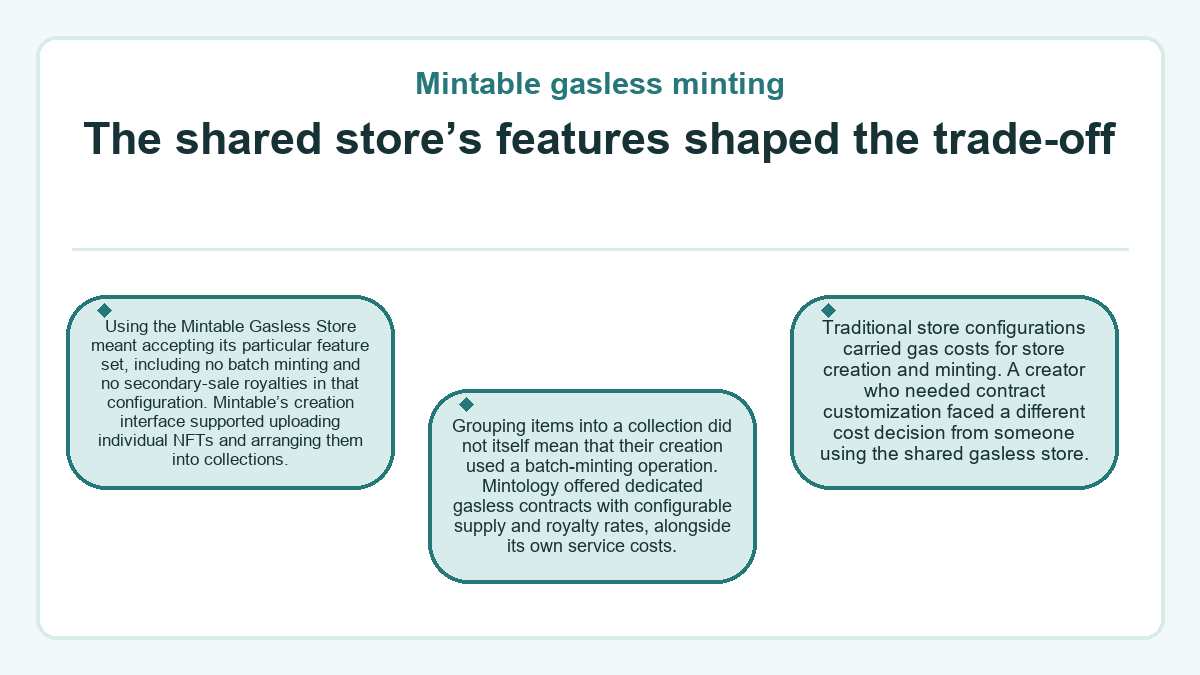
Using the Mintable Gasless Store meant accepting its particular feature set, including no batch minting and no secondary-sale royalties in that configuration. Mintable’s creation interface supported uploading individual NFTs and arranging them into collections. Grouping items into a collection did not itself mean that their creation used a batch-minting operation.
Mintology offered dedicated gasless contracts with configurable supply and royalty rates, alongside its own service costs. Traditional store configurations carried gas costs for store creation and minting. A creator who needed contract customization faced a different cost decision from someone using the shared gasless store.
A paid transfer after gasless creation
In this hypothetical historical example, a creator already had a gaslessly created Ethereum NFT whose ownership record matched the sending wallet. That wallet held enough ETH for a separate transfer. Assume the wallet estimated 54,618 gas at an effective gas price of 7.8 gwei.
After checking the NFT and recipient, the creator authorized the transfer with a fee cap that allowed a higher effective price. The estimate implied 54,618 × 7.8 = 426,020.4 gwei, or 0.0004260204 ETH.
The transfer then completed using 54,618 gas at an effective price of 9.8 gwei. Its successful on-chain NFT transfer record identified the intended recipient and established completion. A signature or a pending transaction hash alone would not have established arrival.
Using the completed transfer’s inputs, 54,618 × 9.8 = 535,256.4 gwei, or 0.0005352564 ETH. That was 0.000109236 ETH above the earlier estimate. The price per gas explained the increase because gas use stayed constant. The entire bill concerned the later transfer, with no additional charge for the original gasless creation.
Why could a later transfer fail after a free mint?
A creator-submitted transfer could fail because its sending wallet lacked the required ETH or its gas limit did not cover execution. The earlier gasless creation did not fund subsequent transactions. Mintable’s manual transfer flow also required the connected wallet that owned the NFT. Selecting a different connected wallet did not establish authority over that token.
Gas that an unsuccessful on-chain execution consumed still cost ETH. Reducing the gas limit could therefore turn an attempted saving into a failed transfer expense. A pending transaction represented a different state from a completed failure; a transaction identifier alone did not settle either outcome.
A wrong recipient created a separate problem: the transaction could complete successfully while sending the NFT somewhere unintended. Ethereum transfers did not offer an undo control. Checking the recipient before authorization addressed that risk; a successful receipt could not correct a mistaken destination.
The wind-down changed the purpose of revisiting old mints
Mintable announced its NFT platform wind-down in 2026 and described a business pivot with the company continuing to operate. The old gasless instructions explain its historical creation offer. They do not establish that a new minting session remains available during the transition. Existing NFT holders instead face questions about continued access to their assets and associated data.
The team announced custodial wallet migration and continued metadata hosting, which addressed different parts of that access. It tied hosting to the company’s continued operation and described a decentralized move if the company later closed. These were transition commitments, separate from the earlier minting fee waiver.
An existing NFT’s contract address and token identifier locate the asset on its network. Keeping those details with wallet records preserves a way to identify it when a familiar marketplace screen no longer helps.
Questions and answers about Mintable gasless minting
Did selecting Mint only require putting the gasless NFT up for sale?
Selecting Mint only created the NFT without listing it for sale. That option let a creator retain an item or prepare it before an intended release. The choice concerned sale availability; the selected minting route determined how the creation cost worked.
Did Mintable require an existing external wallet for gasless creation?
Mintable offered an account-provided custodial wallet, so a previously configured external wallet was not compulsory for that entry path. Other historical instructions used a connected external wallet. The gasless fee claim concerned NFT creation, and the wallet setup depended on the interface and custody option.
How did bulk listing differ from batch minting for gasless NFTs?
Bulk listing offered several existing NFTs for sale together; it did not create those tokens in a batch. Mintable’s collection tool applied the entered price uniformly to the selected items. Creators who wanted different asking prices needed individual listings, independently of how the NFTs had originally been minted.
Could burning a gaslessly created NFT avoid another gas payment?
Burning through Mintable’s Ethereum transfer flow required gas paid in ETH, even when the original creation had cost the creator no minting gas. The burn made the token inaccessible permanently. Its transaction history remained public, and linked media could continue to exist.
Was a separate payment required to unlock earnings from gasless NFT sales?
Mintable’s collection-listing flow deducted marketplace fees from earnings and sent the net proceeds to the wallet without requiring a separate payment. If a Mintable custodial wallet froze after receiving sale proceeds, its holder had to take custody before accessing the funds. ETH used for a creator-submitted transfer paid for that different blockchain action. A request for a seed phrase was not part of receiving sale earnings.